Archive
OpenStack Design Summit – Day 2 Review
Another great day at the OpenStack Design Summit in beautiful San Antonio, Texas.
Here are some of the highlights:
- A lot of great business and technical discussions including details around the upcoming Bexar release. Important discussions around brand, trademarking, governance, and use cases.
- Caught wind of an OpenStack conference happening in Tokyo next week – very cool! Get more info at openstack.org if you want more info.
- Had a lot of attendees take me up on a live tour of the Dell PowerEdge C gear at the summit, which will be powering the InstallFest Thursday and Friday. Lots of questions around the particular models represented (which includes PE-C 6100, 6105, 2100, and 1100). If you’re still at the event, and interested in checking it out, find a Dell guy (there are a few of us around today) or tweet me @jbgeorge, and we’ll get you a sneak peek.
- Barton George (@barton808) has posted a number of great interviews and videos from the event – be sure to check it out at www.bartongeorge.net
- Captured a few pictures of the business sessions yesterday, which had a lot of great discussion

Greg Althaus and Brent Douglas from Dell Data Center Solutions discussing deployment

Bret Piatt discussing OpenStack Compute
Again, for the latest happenings at the Design Summit, search Twitter for #openstack (direct link = http://twitter.com/#search?q=%23openstack). You can also learn more about OpenStack at www.openstack.org.
I’ll actually be heading back today, so will miss a bulk of the InstallFest (work beckons!)
Was great seeing everyone again, and look forward to the next one!
Until next time,
JBGeorge
www.jbgeorge.net / @jbgeorge
OpenStack Design Summit – Day 1 Review
Wanted to provide some visibility to the great stuff happening at the OpenStack Design Summit at the Weston Center in San Antonio.
- Intention is to draft requirements and specs for the January release of OpenStack
- ~300 attendees total – 90 companies and 12 countries represented
- Companies in attenance include Dell, Citrix, RightScale, Cloudkick, Canonical, NASA, and many others
- Technical and business tracks running touching on topics like evolution of the datacenter, Bexar release plans, and many others
- Lots of Twitter action via #openstack
- Discussion of cloud deployments from the hardware perspective, the software perspective, the services perspective
- Lots of hallway conversations between companies – networking-a-rama!
- Great party at Rackspace HQ last night
- Pictures Day 1 at from the event at http://www.flickr.com/photos/pinhole/tags/openstack/ and http://www.openstack.org/blog/2010/11/openstack-design-summit-day-1-pictures/
Will try to provide an update tonight after today’s festivities as well.
Some personal thoughts that have been ruminating lately, and are becoming confirmed in my mind this week.
- No matter what side of the fence you’re on, cloud will need to eventually settle at a model that allows users to evaluate needs, business strategy, etc, then decide HOW MUCH to put in the hosted / public cloud, HOW MUCH to put in the private cloud (whether on premise or of premise), and then implement a BURSTING capability.
- Services are going to be a key part of broader migration to the cloud, especially at the enterprise level
- We, as a group, are doing better on this, but we’re not spending enough time understanding and designing the networks that will drive our clouds. More thought, discussion, and debate need to be done on this topic asap.
For the latest happenings at the Design Summit, search Twitter for #openstack (direct link = http://twitter.com/#search?q=%23openstack). You can also learn more about OpenStack at www.openstack.org.
Also, if you’re at the event, and interested in seeing the Dell PowerEdge C servers that are running at the event, and will power the InstallFest later this week, find me, tweet me, etc, and I’ll get you into the server room.
Until next time,
JBGeorge
www.jbgeorge.net / @jbgeorge
Why QWERTY?
It amazes me how incredibly computer savvy both of my kids are now.
Maybe that shouldn’t surprise a dad with two kids less than five years old. It’s just that one moment they’re searching for dinosaurs on Google, then the next moment, they’re fighting each other for the last jelly bean.
Anyway, today my oldest asked me why the computer keyboard was all out of order. Why do es it go Q-W-E-R-T-Y-… when it should go A-B-C-D-E-… I explained that there are certain letters that are used more often than others when you write / type words, and that this design was used by a lot of people over many years, and is the best and fastest way to type.
And then she asked, “Are you sure it’s the best?”
( Kids. Always with the backtalk.)
So we started out on the path to figure it out. We googled QWERTY, and a number of interesting texts came up discussing the matter. After a few minutes of reading, some healthy discussion, and a couple of shots of chocolate milk, here’s what we came up with.
The QWERTY model was actually developed quite a long time ago, in the late 1800s, and evolved over a number of attempts at an effficient keyboard, including one that started “A-B-C-D-E-…” The key here is that a few of the pioneers in this space happened to be tied into a company that put out one of the earliest “writing machines”, which embedded the QWERTY format into its model, and marketed the hell out of it. Next thing you know, its everywhere.
(We’ve seen that movie before.)
We also learned about a science known as “letter pair frequency” – for example the frequency of the consecutive letters “th” in the English language is 1.52%, while the frequency of the consecutive letters “ur” is 0.02%. This is a key part of defining how the letters were to be arranged. A lot of pretty smart people spent a lot of time figuring that out. God bless ’em.

Fair question...
So, it’s clear that QWERTY is a pretty good system, based on actual science. But our question here was “Is QWERTY the best?”
Turns out there are a number of issues with the QWERTY model – a lot of the most frequent letter combinations require the same finger to type it, one hand ends up typing more than the other in a lot of cases, etc, etc, etc.
One of the most famous contrarians to QWERTY was a gentleman by the name of Dvorak, inventor of the Dvorak Simplified Keyboard, seen below. It was apprently developed with a focus on letter pair frequencies and hand physiology. In fact, some Dvorak-ites claim less of a chance of carpal tunnel with this keyboard.
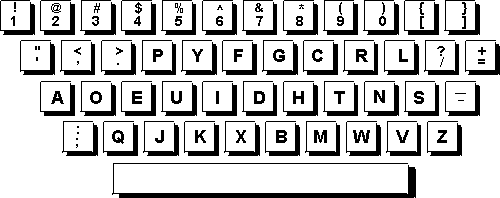
The Dvorak Keyboard (Source: http://www.dvorak-keyboard.com)
Some interesting facts we uncovered about the Dvorak keyboard:
- The home keys are made up of the vowels and the most used consanants.
- You can type ~400 of English’s most common words with just the Dvorak “home keys” (vs ~100 on QWERTY).
- In general, ~70% of typing occurs on the Dvorak home keys (vs ~30% on QWERTY)
- Dvorak attempts to make stroking motion go from the outside of keyboard toward the middle, based on the assumption that its easier to tap your fingers from pinky to pointer vs the other way around
- Some operating systems offer you the option to configure your keyboard in the Dvorak model
Interesting stuff, no?
At this point, knowing that our research was far from thorough, we figured that no matter how interesting or scientifically superior that Dvorak model may prove to be, QWERTY has engrained itself so deeply into our culture at this point that it’s difficult to see the mainstream world changing.
On computers, that is.
It will be interesting to see how / if this becomes more of a discussion topic now that we’re heading toward smaller mobile devices, tablets, etc. Also with advances like smart typing (aka autocorrect) and the “SWYPE” techinque for mobile keyboards, perhaps the opportunity to better fine tune the keyboard will present itself.
So is QWERTY the best? Probably not.
Will the world likely adapt a better model in light of newer input devices?
Well, maybe it’s time we thought about it.
It is also at this point that I realize my kid is long gone, and is now watching Disney channel upstairs. Oh, well.
At least she’s watching Little Einsteins. 🙂
(“Princess, can you help Daddy reset the computer keyboard back to QWERTY?”)
Until next time.
Joseph B George
@jbgeorge / www.jbgeorge.net
SOURCES:
 The JBGeorge Tech Blog