Archive
OpenStack’s Bexar Release!
On Thursday, OpenStack announced the second drop in the OpenStack code – the Bexar release!
(And it’s pronounced “bear”.)
(The other acceptable pronunciation is “bare.”)
For those of you keeping track, the first release was Austin, the second release was Bexar, and the next release is codenamed Cactus.
(Can you see the pattern?)
(That’s right, every code name has an “a” in it.)
…
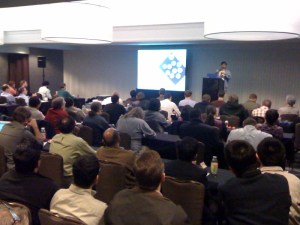
Dell's Rob Hirschfeld discussing cloud bootstrapping to packed house...
To celebrate this release, OpenStack sponsored an event in Santa Clara that I was able to attend. Great lightning talks (5 min max) by a number of individuals in the community, including my pal Rob Hirschfeld, who spoke about bootstrapping the OpenStack cloud in a hyperscale environment. (Check out his blog at RobHirschfeld.com, and follow @zehicle on Twitter.)
So let’s get back to the release here – it includes things like
- IPv6 support (which is just in time, since we’ve now RUN OUT of IPv4 addresses!)
- Support for the Microsoft Hyper-V hypervisor (already supported KVM and XenServer)
- A new image discovery service called Glance
- much more documentation
Check out this eWeek article where Barton George and I gave our thoughts on this release: http://www.eweek.com/c/a/Cloud-Computing/OpenStack-Cloud-OS-Project-Rolls-Out-Bexar-Edition-New-Partners-234666/
Here’s a quote from yours truly:
It’s time to take the “learning to the next level” by putting Dell servers with OpenStack in customer environments to “see real-life use cases,” Joseph George, senior cloud-solutions strategist at Dell Data Center Solutions, told eWEEK.
And I mean it – let’s start piloting this stuff!
Who’s with me?
I’ll put my Dell hat on and say that Dell is actively seeking customers interested in doing a proof of concept of OpenStack (aka POC) – we’ve been testing it, and understand how to get you going quick so you can prove it out.
Am I proud to be working for the only systems solution vendor that has been publicly participating in the OpenStack initiative since the beginning of OpenStack?
Heck yeah.
In fact, Dell DCS has a great cloud solutions portfolio – drop me a line / comment if you’re ready to get a POC going – we’ll get it rolling.
OK, back to our regularly scheduled programming…
Oh, wait. I guess I’m done.
Don’t forget Sunday is Superbowl Sunday – between the commercials, and the actual game, there’s something for everyone. Here’s to a high scoring, low injury game!
And thus begins the season of prayer in hopes the NFL and the Players Association work out a collective bargaining agreement, so we can have a 2011 season.
Amen.
Until next time,
JOSEPH
@jbgeorge
www.jbgeorge.net
Cloud Driving Change
Those of you that follow me here at the JBGeorge Tech blog or on Twitter or in other ways (stop stalking me!) know that one of my passions is how technology can make a difference in the world. It can be through technology leaders advocating philanthropy, tech innovation leading to medical advances, or a local IT person donating their tech talent to improve school safety.
To that end, I was thrilled to be invited to a meeting that took place in San Francisco yesterday.
On Monday, I, along with a few other select individuals involved in the OpenStack open source cloud initiative, had the distinct privelege of meeting with Aneesh Chopra, CTO of the White House, to discuss cloud computing, open source, and how open source cloud (specifically OpenStack) can help America grow and thrive.
A number of key representatives from various OpenStack participants were present from Dell, Rackspace NASA, Citrix, AMD, and others to contribute to the discussion. There was a lot of great conversation, which included an overview by the OpenStack team from Rackspace, and a myriad of perspectives from the various attendees. Specific problems were discussed such as security, standards, and impact on other areas like healthcare. Much was discussed about OpenStack in particular, and how its evolution can help spur on the American economy.
What are your thoughts on how cloud can better society? How does it impact education, healthcare, or small business? How can it make us healthier, economically more stable, and overall better citizens? Let’s think beyond operating systems and PaaS / SaaS – what can cloud do to help drive positive change?
Regardless of where you fall politcally, it’s a great time to be in technology. The current administration views tech and cloud computing as a key driver to advancing America and rightly so.
And they’re looking to us to help figure out ways to do that.
That’s a real cool thing. Let’s pitch in.
I’d be interested in hearing your thoughts. Feel free to drop me a comment or reply on Twitter @jbgeorge.
Until next time,
JBGeorge
www.jbgeorge.net
@jbgeorge
Thoughts from 2010 Gartner Data Center Conference (Part 2)
Hello all – hope you’re having a good Saturday / Sunday wherever you might be.
Wanted to finish putting down thoughts, insights, etc from my time at the Gartner Data Center conference this past week. (You can read Part 1 here – https://jbgeorge.net/2010/12/11/thoughts-from-2010-gartner-data-center-conference-part-1/.)
- We need to understand the success / real world utilization of ITIL and other benchmark frameworks – are they working?
- More and more, in the era of cloud, we are finding it is no longer necessary to keep an individual system up at all costs, as long as overall compute and storage integrity are maintained
- Traditional management models assume that systems should be managed so that failure should rarely happen. Newer models assume that failure WILL happen, and focus on shortest MTTR (mean time to recovery / repair).
- Traditional models try to implement pervasive automation, whereas newer models focus on selective automation. Why must we automate / virtualize / etc everything? Choose wisely based on criticality and true need.
- We’ve heard of JEOS – the “just enough” operating system. Gartner spoke of “just enough” practice vs “best” practice. Are we at the era of “just enough?”
- Again, reiteration of the need of DevOps skillset.
- Organizational alignment is still a key facet of moving the IT organization.
- “We are only at the end of the beginning” of the cloud era. Watch for Cloud 2.0 in the years ahead (market based computing, hybrid clouds the norm, etc)
- Still a lot of talk about the Big Four (HP, CA, IBM, BMC) – they were slow to jump on w virtualization, but more aggressive with cloud.
- Definite focus on the network being a key management focal point. Similar to the theory that your band’s ripping concert is only as good as the quality of your sound man.
- The recession will be viewed in hindsight as a pivot event for the server market – paradigm shifts, vendor repositioning, etc.
- Some important trends to watch going forward: big data, unified communication, client virtualization, compute density / scaling vertically, converged fabrics
Another great event – look forward to next year.
Until next time,
JBGeorge
@jbgeorge
Thoughts from 2010 Gartner Data Center Conference (Part 1)
This week, I had the pleasure of attending the 2010 Gartner Data Center conference – got to see a lot of old friends, meet new friends, and learn a lot about what Gartner sees coming down the road.

This year's Gartner Data Center Conference was held at Caesar's Palace, Las Vegas, NV
It was also a chance to talk to a number of folks about what’s happening at their own data centers, what they’re looking to solve, and what they’d like to see start happening in the industry.
Here are some key nuggets I walked away with – I’ll post again tomorrow with the rest:
- When it comes to implementing cloud, we cannot allow “20th century industrial models to sap 21st century innovation.”
- There’s still not a good answer for failure remediation in the cloud – credit due to downtime is just not good enough.
- Expect the community cloud concept to continue to draw interest. (Community clouds are clouds that service specific areas like banking or healthcare, where compliance, etc would be a requirement for its customers.)
- The next big business opportunity could be cloud brokers as the new systems integrators
- Great quote from Phil Dawson regarding due diligence before virtualizating anything – “Don’t virtualize rubbish – otherwise you have virtual rubbish.”
- We often forget that virtualization is more than just servers and storage – there are apps, desktops, etc
- Client virtualization / VDI is still top of a number of minds, though many are still at the investigative stage. There are still lingering questions about user adoption, bandwidth / network constraints, and ROI. (Though I am a big believer.)
- When we build staffs, we should strive for them to be “T-shaped” – technically deep in few areas, but linkages to the broader business.
- It’s important to run IT as a business – remember that it is providing something of value that its customer is willing to pay for
- Some good discussion on IT chargeback and allocation, which many are not doing today, but forsee implementing in the future. Four required characteristics of IT chargeback: simplicity, fairness, predictability, and control.
Also got a walkthrough of the IBM containerized data center, as well as SGI’s container – both very cool. (No pun intended.) I’ve now had the pleasure to see the modular / container data centers from HP, Dell, IBM, and SGI first hand.
Some interesting stats and statistical predictions from Gartner:
- 2/3 of the live audience was polled said they will be pursuing a private cloud strategy by 2014
- What’s the top concern regarding cloud computing? Security and privacy are still at the top.
- If Facebook were a country, it would be the third largest in the world. Twitter – the 7th. (Wow.)
- There has been more video uploaded to YouTube in the last 2 months than if ABC, NBC, and CBS had been airing content 24/7/365 continuously since 1948. (WOW.)
- Data centers can consume 40x – 100x more energy than the offices they support.
- An 8,000 square foot datacenter could cost $1.6M per year for just power.
- Data centers will be significantly smaller in the next 5 – 10 years
- Data expected to grow 800% over the next 5 years, and 80% of it will likely be unstructured.
- Today’s labor force will have 10 – 14 jobs by age 38
As you can tell, just a lot of good discussion on cloud, data centers, power, and overall IT.
OK, don’t want to overload more than I have – will back tomorrow night.
(UPDATE: Click here for Part 2.)
Until next time.
JBGeorge
@jbgeorge
OpenStack Design Summit – Day 2 Review
Another great day at the OpenStack Design Summit in beautiful San Antonio, Texas.
Here are some of the highlights:
- A lot of great business and technical discussions including details around the upcoming Bexar release. Important discussions around brand, trademarking, governance, and use cases.
- Caught wind of an OpenStack conference happening in Tokyo next week – very cool! Get more info at openstack.org if you want more info.
- Had a lot of attendees take me up on a live tour of the Dell PowerEdge C gear at the summit, which will be powering the InstallFest Thursday and Friday. Lots of questions around the particular models represented (which includes PE-C 6100, 6105, 2100, and 1100). If you’re still at the event, and interested in checking it out, find a Dell guy (there are a few of us around today) or tweet me @jbgeorge, and we’ll get you a sneak peek.
- Barton George (@barton808) has posted a number of great interviews and videos from the event – be sure to check it out at www.bartongeorge.net
- Captured a few pictures of the business sessions yesterday, which had a lot of great discussion

Greg Althaus and Brent Douglas from Dell Data Center Solutions discussing deployment

Bret Piatt discussing OpenStack Compute
Again, for the latest happenings at the Design Summit, search Twitter for #openstack (direct link = http://twitter.com/#search?q=%23openstack). You can also learn more about OpenStack at www.openstack.org.
I’ll actually be heading back today, so will miss a bulk of the InstallFest (work beckons!)
Was great seeing everyone again, and look forward to the next one!
Until next time,
JBGeorge
www.jbgeorge.net / @jbgeorge
Why QWERTY?
It amazes me how incredibly computer savvy both of my kids are now.
Maybe that shouldn’t surprise a dad with two kids less than five years old. It’s just that one moment they’re searching for dinosaurs on Google, then the next moment, they’re fighting each other for the last jelly bean.
Anyway, today my oldest asked me why the computer keyboard was all out of order. Why do es it go Q-W-E-R-T-Y-… when it should go A-B-C-D-E-… I explained that there are certain letters that are used more often than others when you write / type words, and that this design was used by a lot of people over many years, and is the best and fastest way to type.
And then she asked, “Are you sure it’s the best?”
( Kids. Always with the backtalk.)
So we started out on the path to figure it out. We googled QWERTY, and a number of interesting texts came up discussing the matter. After a few minutes of reading, some healthy discussion, and a couple of shots of chocolate milk, here’s what we came up with.
The QWERTY model was actually developed quite a long time ago, in the late 1800s, and evolved over a number of attempts at an effficient keyboard, including one that started “A-B-C-D-E-…” The key here is that a few of the pioneers in this space happened to be tied into a company that put out one of the earliest “writing machines”, which embedded the QWERTY format into its model, and marketed the hell out of it. Next thing you know, its everywhere.
(We’ve seen that movie before.)
We also learned about a science known as “letter pair frequency” – for example the frequency of the consecutive letters “th” in the English language is 1.52%, while the frequency of the consecutive letters “ur” is 0.02%. This is a key part of defining how the letters were to be arranged. A lot of pretty smart people spent a lot of time figuring that out. God bless ’em.

Fair question...
So, it’s clear that QWERTY is a pretty good system, based on actual science. But our question here was “Is QWERTY the best?”
Turns out there are a number of issues with the QWERTY model – a lot of the most frequent letter combinations require the same finger to type it, one hand ends up typing more than the other in a lot of cases, etc, etc, etc.
One of the most famous contrarians to QWERTY was a gentleman by the name of Dvorak, inventor of the Dvorak Simplified Keyboard, seen below. It was apprently developed with a focus on letter pair frequencies and hand physiology. In fact, some Dvorak-ites claim less of a chance of carpal tunnel with this keyboard.
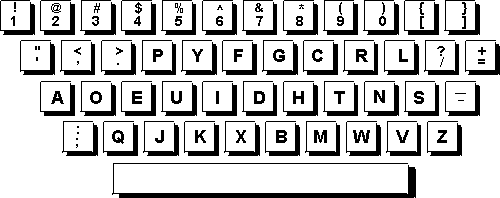
The Dvorak Keyboard (Source: http://www.dvorak-keyboard.com)
Some interesting facts we uncovered about the Dvorak keyboard:
- The home keys are made up of the vowels and the most used consanants.
- You can type ~400 of English’s most common words with just the Dvorak “home keys” (vs ~100 on QWERTY).
- In general, ~70% of typing occurs on the Dvorak home keys (vs ~30% on QWERTY)
- Dvorak attempts to make stroking motion go from the outside of keyboard toward the middle, based on the assumption that its easier to tap your fingers from pinky to pointer vs the other way around
- Some operating systems offer you the option to configure your keyboard in the Dvorak model
Interesting stuff, no?
At this point, knowing that our research was far from thorough, we figured that no matter how interesting or scientifically superior that Dvorak model may prove to be, QWERTY has engrained itself so deeply into our culture at this point that it’s difficult to see the mainstream world changing.
On computers, that is.
It will be interesting to see how / if this becomes more of a discussion topic now that we’re heading toward smaller mobile devices, tablets, etc. Also with advances like smart typing (aka autocorrect) and the “SWYPE” techinque for mobile keyboards, perhaps the opportunity to better fine tune the keyboard will present itself.
So is QWERTY the best? Probably not.
Will the world likely adapt a better model in light of newer input devices?
Well, maybe it’s time we thought about it.
It is also at this point that I realize my kid is long gone, and is now watching Disney channel upstairs. Oh, well.
At least she’s watching Little Einsteins. 🙂
(“Princess, can you help Daddy reset the computer keyboard back to QWERTY?”)
Until next time.
Joseph B George
@jbgeorge / www.jbgeorge.net
SOURCES:
 The JBGeorge Tech Blog