Archive
THIS JUST IN: VMware and Dell Partner to Enable Cloud Foundry via #Crowbar
.
And the goodness just keeps on coming!
 A few weeks ago, Dell (they company I work for) unleashed the power of the Dell developed, open source Crowbar software framework as a part of the announcement of the Dell OpenStack Cloud Solution. It allowed users to deploy a full OpenStack IaaS cloud on bare metal PowerEdge C servers in less than two hours (vs multiple days if done manually), and allows for a continuous integration mechanism for the stood up cloud.
A week later, we announced the Dell | Cloudera Solution for Apache Hadoop, which also leverages the powerful Crowbar software to deploy a running Hadoop cluster on to bare metal PowerEdge C servers in less than a day, where it can take days or even weeks if deployed by other means.
So….
Infrastructure as a Service (IaaS)? Check.
Hadoop / Big Data? Check.
But what about Platform as a Service (PaaS)?
Big time check.
 Today, VMware is announcing their development of a Cloud Foundry barclamp for Dell’s Crowbar software!
VMware’s Cloud Foundry is an open platform as a service (PaaS) project initiated by VMware designed to support multiple frameworks, multiple cloud providers, and multiple application services all on a cloud scale platform. It’s a project that is only a few months old, but one that has been getting outstanding interest from enterprises who want PaaS to be the new developer UI to their private cloud. And Cloud Foundry is already powering real solutions.
And now it can be deployed quickly, simply, and automated with Dell’s Crowbar software.
Crowbar, software that leverages OpsCode’s Chef configuration management tool, allows users to get up and running on powerful technologies like Cloud Foundry, but actually does much more. It actually does BIOS configuration, RAID configuration, network discovery, deploys Nagios and Ganglia, and more to enable an environment ideal for complex technologies. It is also aware of changes in its environment, and adjusts to them in an automated manner. (Learn more about Crowbar here.)
This is another win for open source in my book, and a real indicator of the impact open source is going to have on the next era of IT.
 So who’s the next Crowbar barclamp rockstar?
You tell me.
You. Crowbar. Download. Build barclamp. Share.
I’d love to be telling your story here next. 🙂
More info:
- The Cloud Foundry Blog – http://blog.cloudfoundry.com
- Get open source Crowbar – www.github.com/DellCloudEdge
- Rob Hirschfeld’s Blog (Dell)
- Barton George’s Blog (Dell)
Until next time,
JBGeorge
@jbgeorge
Big News: #Dell and #Cloudera Partner on #Hadoop Solution
.
Big news!
 Today, Dell (the company I work for) has announced a solution offering in conjunction with Cloudera, called the Dell | Cloudera Solution for Apache Hadoop! It’s a fully deployable Hadoop solution made up of Dell PowerEdge C hardware, Dell and Cloudera software, and Dell and Cloudera services – the complete package.
(Note that this is the second solution that my team has put out in the last two weeks – if you missed last week’s OpenStack announcement, you can get more info here.)
But on to the star of today’s show!
We’d often hear from our customers that they were experimenting with Hadoop on Dell hardware to analyze sales data, marketing information, etc in order to better serve their own customers. And pretty soon, we were being asked, “What’s Dell’s point of view? What recommendations do you have for distributions, architecture, and implementation?”
 Well, here’s the answer. The Dell | Cloudera Solution for Apache Hadoop.
What’s Under the Hood
- Hardware – similar to OpenStack, the reference architecture that this solution is built on is the innovative Dell PowerEdge C server line. Based out of Dell’s well known Data Center Solutions team (aka DCS), PowerEdge C server technology was born out of learnings from custom engagements with some of the biggest cloud and hyperscale environments in the world. What we discovered is that, despite custom requirements and specs, there was some commonality among the requests. Concepts like density, power efficiency, etc were at the top of the list when it came to these environments.
So we took what was common and built a line of servers that was ideal for cloud and hyperscale environments, which became the Dell PowerEdge C server family. And it is an ideal platform for our Hadoop solution, as all the tenets of scale apply when building out an optimal Hadoop instance.
- Software – Our partners, Cloudera, who are among the most established Hadoop vendors in the market, will be providing their distributions of the Hadoop software, as well as their CDH management tools, which are top notch. In addition, Dell will be providing our Crowbar software framework and a specific Cloudera barclamp as part of the solution. (As a refresher, we announced availability of Crowbar last week as part of our OpenStack announcement, which helps speed deployment CONSIDERABLY. In the case of the Dell Cloudera Solution for Apache Hadoop, it can speed bare metal deployment of a Hadoop cluster from days or weeks to less than one day!)
- Services – Dell and Cloudera are partnering to enable our customers to get going on a validated instance of Hadoop, and offer a variety of services from support of the entire stack of hardware and software, as well as training on the technologies that will enable our customers on Hadoop.
Now’s the time to get started on Hadoop, and the Dell | Cloudera Solution for Apache Hadoop can get you there.
Find out more about this new solution at www.Dell.com/Hadoop or get in touch with us at Hadoop@Dell.com.
More info:
- The Dell Cloudera solution website – http://www.Dell.com/Hadoop
- Barton George’s blog – http://bartongeorge.net/2011/08/04/introducing-the-dell-cloudera-solution-for-hadoop-harnessing-the-power-of-big-data/
- Rob Hirschfeld’s blog – http://www.RobHirschfeld.com/2011/08/04/dell-cloudera-hadoop
- My recent blog about Crowbar – https://jbgeorge.net/2011/08/01/the-dell-crowbar-software-framework-who-what-when-where-and-how/
- Email us for more info at Hadoop@Dell.com
Until next time,
JBG
@jbgeorge
The #Dell #Crowbar Software Framework: Who, What, When, Where, and How
.
It’s been about a week since Dell (the company I work for) officially announced the Dell OpenStack Cloud Solution, the market’s first HW / SW / Services solution for OpenStack – and the response has been great!
(Check out my last blog post about it here for more details.)

Crowbar from Dell
Since this wasn’t your average announcement with a big company like Dell actually contributing to the community, I received a number of questions, comments, and accolades around our contributed software framework – Crowbar.
So I thought I’d pass on some of the people, history, functionality, and background behind Dell’s Crowbar software.
History
Since Dell had been a committed partner of OpenStack’s since it’s announcement in July of 2010 (over a year ago), we were among the first to begin working with the OpenStack code as we began developing the Dell solution for it. Since it was very early, very raw code, there was a lot of installing / testing / coding / re-testing / blowing it away / reinstalling / testing / coding / re-testing / blowing it away… you get the idea.
And as any cloud technology goes, deploying OpenStack on bare metal took time, effort, and expertise.
It wasn’t long before our solutions development team decided we’d automate this process to make our efforts quicker. But lo and behold, we discovered that others in the community were dealing with the same thing. A few early users indicated that it was taking them a full day to deploy OpenStack from start to finish, and in most cases, it was taking multiple days.
So we decided build out a quick, automated method of deploying OpenStack on bare metal technology that the whole community could use.
And Crowbar was born.
Functionality
Extending the capabilities of the Chef configuration management framework from Opscode, our team began developing Crowbar with the goal of installing a multi-node OpenStack cloud on bare metal PowerEdge C servers in less than four hours. “Multi-node” was a key requirement as almost every use case we encountered required that.
We announced Crowbar’s existence and development in early 2011, with our intent to field test, and then release to the open source community. Over the course of time, we began testing it out in various instances and scenarios, as well as demo-ing it at various cloud events. Many of you may remember us showcasing our progress at SCaLE, CloudConnect, and the Apr OpenStack Design Summit (which Dell sponsored).
With time and experience, we came across a number of requirements for this type of a tool – automated BIOS configuration, RAID configuration, network discovery and set up, installation of the open source system monitoring tool Nagios, installation of the open source performance monitoring tool Ganglia, and more. So we built it all in.
And based on the extensive cloud cloud experience on our team, we knew that cloud development and management is an ever evolving exercise – as the Dell OpenStack lead architect and OpenStack community celeb Rob Hirschfeld would say, “Cloud is always ready, and never finished.” So Crowbar is designed in a way to manage change. Add in a new supported server to the mix, and Crowbar detects it and proceeds to add it to the OpenStack pool. When software needs to be updated, Crowbar can be leveraged to update once, and deploy to all.
Barclamps
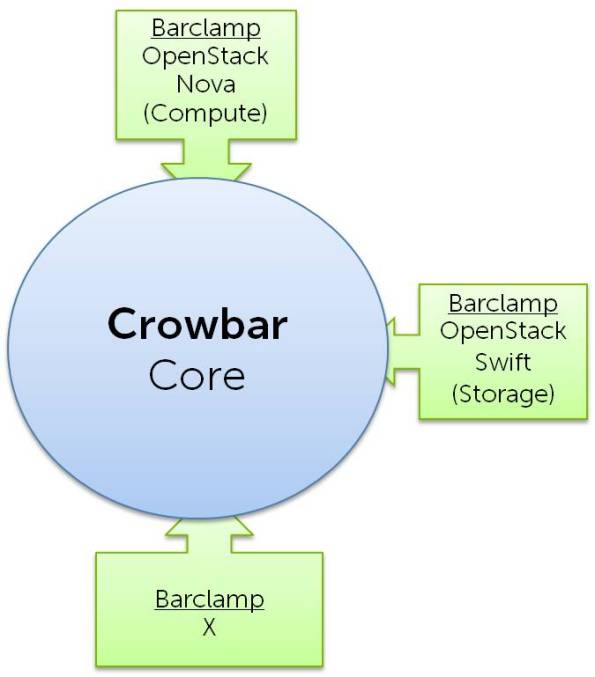
Dell Crowbar featuring Barclamps!
And what about new components that come out? There are a number of new OpenStack capabilities coming out of various projects – how do those get rolled in?
Barclamps.
(Yes, we designed Crowbar with modularity in mind.)
Think of it this way: Crowbar is made up of two general functionality categories – the Crowbar core and Crowbar barclamps. The Crowbar core contains all the main functionality that allows Crowbar to perform tasks. Barclamps are modules that actually perform a function. So need to deploy OpenStack Nova (aka cloud compute)? Leverage the Nova barclamp. Need to deploy OpenStack Swift (aka cloud storage)? Leverage the Swift barclamp.
Need to deploy some software that doesn’t have a barclamp?
You can create your own barclamp!
And that’s the beauty of Crowbar – we created (and will continue to create) barclamps that work for our customers, but we’re encouraging / training our customers to develop their own barclamps, and we want the community at large to do the same.
What real customers are doing with the Crowbar and the Dell OpenStack Cloud Solution
In our press release, one of our OpenStack customers, DreamHost, spoke about their success with the Dell OpenStack Cloud Solution. Along with Dell server technology and services, the innovative DreamHost team really picked up on the Crowbar tool. In fact, as they are working on hosted options for their Ceph technology, the DreamHost team has begun developing a barclamp for Ceph!
In fact, here’s what the DreamHost GM of Emerging Technologies, Ben Cherian, had to say about Crowbar:
“If Dell had not developed Crowbar, we would have been forced to write a similar tool ourselves. It’s a fundamental goal that we have in the company: automate, automate, automate. That’s how we drive down prices.”
Ben also went on to say that since Dell had already developed a technology like Crowbar, we ended up saving them four to six months of development time.
Common Questions
- Is Crowbar for Dell products only?
The Crowbar software that we’ve developed at Dell will obviously work with Dell supported platforms. But there is no reason that this framework will not work for any other vendor technology – all that needs to happen is for that vendor / user / community member to create a barclamp for that technology.
- Is Crowbar for OpenStack only?
Obviously, our original use case is for OpenStack – it has been tested and validated for that model. However, again, it is a flexible software framework. We can see a number of use cases for OpenStack, and welcome the community to use it where it makes sense.
- What do I get with Crowbar as a part of the Dell OpenStack Cloud Solution vs open source Crowbar?
There are two main differences at this point:
First, open source Crowbar has everything that the Dell OpenStack Cloud Solution Crowbar has, except for the BIOS and RAID capabilities, where we’re trying to clear some legal hurdles before we open source. Once those are cleared, we expect to open source those capabilities.
Second, when you get Crowbar as a part of the Dell OpenStack Cloud Solution, you will get full support from Dell via Dell Services. Any questions, support, training you need on Crowbar, Dell delivers it.
Where do I get Crowbar?
OK, the question of the hour. How do you get Crowbar?
- You get Dell-supported Crowbar when you purchase the Dell OpenStack Cloud Solution.
- You get open source Crowbar from our github site – http://www.github.com/dellcloudedge.
You can head over to http://www.RobHirschfeld.com and see much more TECHNICAL content on the Dell OpenStack Cloud Solution and Crowbar. In addition to being our lead architect on OpenStack, Rob is actually one of the developers of the actual Crowbar software. (You can also follow him on Twitter at @zehicle.)
And as always, if you want to learn more about the Dell OpenStack Cloud Solution, you can head to http://www.Dell.com/OpenStack. Or if you’d like to reach out to us to learn more, drop me and the gang a line at OpenStack@Dell.com.
Until next time,
JOSEPH
@jbgeorge
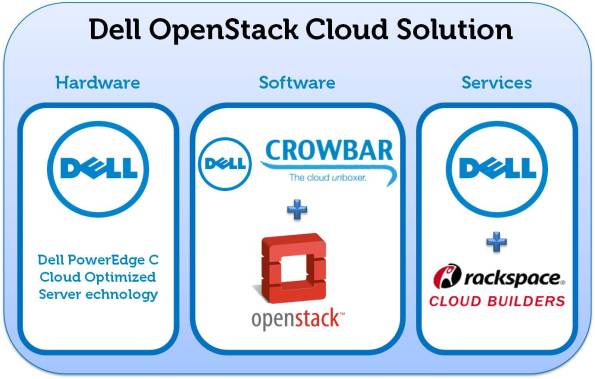
Dell OpenStack Cloud Solution
THIS JUST IN: Dell Announces the Dell OpenStack Cloud Solution
.
On the heels of the one year anniversary of the OpenStack open source cloud operating system – here’s some awesome news…
Dell (the company I work for) announces the Dell OpenStack Cloud Solution, the market’s first hardware + software + services OpenStack solution for customers seeking to build out their own OpenStack clouds!
Let’s take a look under the hood, shall we?

Dell OpenStack Cloud Solution
Hardware (Dell PowerEdge C cloud optimized servers)
Built on a reference architecture honed since DAY ONE of the OpenStack movement, the Dell OpenStack Cloud Solution offers a hardware configuration featuring cloud optimized Dell PowerEdge C servers. Dell has built cloud infrastructure for some of the biggest names in the world, like Facebook and Microsoft Azure, and have used those learnings to develop the highly dense, power-efficient PowerEdge C servers that the Dell OpenStack Cloud Solution has been architected with.
Software (Dell Crowbar deploying and managing the OpenStack cloud platform)
When Dell began testing OpenStack in mid 2010, we were installing it, testing it, blowing it away, reinstalling it, tweaking it, blowing it away, reinstalling it… you get the picture. And it wasn’t trivial. These deployments took considerable time, effort, and expertise, so we developed the Dell Crowbar software framework extending Opscode’s Chef automation, which can deploy MULTI-NODE OpenStack clouds in hours or even minutes, rather than days when done manually. (Anyone remember our team deploying a 6 node Nova and Swift OpenStack deployment in 29 minutes at CloudConnect?) Crowbar enables BIOS and RAID setup and configuration, network setup, deploys open source tools like Nagios and Ganglia for monitoring, and much more.
And hey, we’re a community here, right? So here’s what the OpenStack community has been waiting to hear – Dell has now open sourced Crowbar! We’ve made it available to the open source community via our Github site, which is linked below. My partner in crime, Rob Hirschfeld, goes into Crowbar deep on his blog, so I’ve provided a link to his site below as well. (FYI – we are still working through some of the legal aspects of BIOS and RAID capabilities, but decided to open source the rest of Crowbar while we work it out.)
And speaking of support…
Services (Dell Services + Rackspace Cloud Builders)
After a year of being in OpenStack, we’ve built up some expertise, so Dell Services, along with our partner Rackspace Cloud Builders, will be offering a plethora of services to help you make your OpenStack cloud a reality.
- Consulting
- Deployment
- Training
- Support for the entire solution – HW, Crowbar, OpenStack, etc
- And a host of other services direct from Dell Services
When you get the Dell OpenStack Cloud Solution, you can call Dell for support on any aspect of the solution, and we’ll help you figure it out, with our crack support teams, our OpenStack engineers, and our OpenStack partners.
And those are the basics.

Fast. Easy. Now. The Dell OpenStack Cloud Solution
A few more comments….
Let me just say – I am proud that we’ve delivered this solution to market, but even PROUDER to be part of a company had the vision to see the potential of OpenStack on Day One. Yes, that’s a big deal to me.
I’d like to call out a number of partners we’ve worked with to get to this point – Rackspace, Citrix, Opscode, Canonical, Intel, and others – the community is a big deal in OpenStack, and it’s great to have their support in this announcement. I’m also very happy that one of our first Dell OpenStack customers, DreamHost, is a part of this announcement as well with a full case study on how they’re doing OpenStack with Dell. (HINT: they’re neck deep in Crowbar and loving it!)
We plan to celebrate the announcement big time at OSCON, so if you’re here, come by the Dell booth – demos, gear, giveaways, etc. And our breakout session will be on Thursday (10:40am in room E-141) – “Prying Open the Cloud with Dell Crowbar and OpenStack” – Rob will present the deep down details on Crowbar.
(And if you want to get in on the celebration, feel free to tweet the news and your thoughts – be sure to use hashtags #Dell, #OpenStack and #Crowbar…)
So What’s Next?
Time for YOU to start using this. The Dell OpenStack Cloud Solution, Crowbar, all of it. Talk to your Dell rep, emaial us at OpenStack@Dell.com, download Crowbar, start building Crowbar barclamps, discuss it in the forums, etc… and get started building OpenStack clouds with Dell.
More info:
- Dell OpenStack webpage
- Crowbar’s open source repository
- Press Release: Dell OpenStack Cloud Solution
- Rob Hirschfeld
- Barton George
- OpenStack.org
- Partners: Citrix Project Olympus, Rackspace Cloud Builders, Opscode Chef, Canonical, and Intel
Until next time,
JBG
@jbgeorge
OpenStack’s First Year: How a Committed Community Made a Difference
.
You know the saying: “Time flies when you’re having fun.”
This week has been a crazy one, so I didn’t get to chime in on Tuesday with my thoughts on the one year anniversary of OpenStack.
So today, I took some time to think back over the last year, and I realized how far we’ve come as a technology and as a community.
In addition to the solid OpenStack technology that is being guided by market requirements and pushing the envelope, I believe that the unique set of OpenStack developers, partners, and users has helped get it to where it is.
Pardon me, while I stroll through memory lane…
Design Summits
- Austin Design Summit (July 13 – 14, 2010) – I’m not sure if we could have called this one a design summit as it was more of a meeting of minds, lots of ideas, and a ton of excitement about this new platform called OpenStack. Got to hear from both Rackspace and NASA on the code bases, and how this could change the market. I specifically recall our group of cloud solution attendees from Dell (the company I work for) talking about how much potential this technology had. (And besides, this meeting was in our home town!)
OpenStack was announced publicly for the first time a few days later on the 19th. Dell was among a handful of companies who believed in the initiative back then – it was early – and we had to have vision.
- San Antonio Design Summit (Nov 9 – 12, 2010) – This was held at the Weston Centre in San Antonio, and I remember thinking “where did all these people come from???” We had a lot of international presence there from the UK, France, Japan, and other parts of the world. It was exciting to think that in just four months, we’d already started going global. I also recall we started talking to the business of OpenStack – licenses, brands, etc, which was a good sign of progress.
Dell did our part as well – Rob Hirschfeld and Greg Althaus, a couple of Dell OpenStack rockstars, each spoke on OpenStack deployment, reference architectures, and operational models. We also contributed gear for the InstallFest later that week, made up of PowerEdge C6100s and C2100s (I also remember giving quite a few tours of the “server room” to see what Austin release was running on.)
- Santa Clara Design Summit (Apr 26 – 29, 2011)– Our first design summit on the west coast! This one is still pretty fresh in my mind, but what blew me away was again, the growth! The community grew and became more sophisticated. Those that were learning at the first two design summits were blossoming experts at this design summit, having lived through the evolution of OpenStack. Though I’m sure it was logistically nuts for the organizers as they greatly exceeded capacity, it was a great indicator that we were on to something special.
The Dell team gave it our all here as well – Rob gave a session on what Dell was doing with OpenStack and Crowbar, and my favorite – daily live demos of Crowbar deploying multi-node OpenStack clouds on bare metal servers! (I’d time our guys – the best time was 29 min minutes for a 6 node OpenStack cloud running on Dell PowerEdge C 6100’s – not too shabby!
(Anyone remember the Crowbar bunny shirts?)
Year One Partners
I just checked the OpenStack.org site, and at THIS MOMENT, there are 91 partners in the community. (Depending on when you read this, there could / will be more.)
You’ll find a number of key industry players there – Rackspace, Dell, Citrix, Intel, AMD, Cisco, Canonical, Brocade, Arista, Opscode, and more. And this group has done a lot to further the intiative over the last year.
Here are a list of a few examples.
- Rackspace announcing the creation of Rackspace Cloud Builders, who’s purpose in life is to service customers on OpenStack deployment, training, support, and consulting.
- Citrix announcing Project Olympus and a distribution of OpenStack to come soon
- Dell announces the Crowbar deployment software for OpenStack, and our intention to release an OpenStack solution to market
- Canonical announces their intention to make OpenStack the default cloud platform in the Ubuntu operating system
- Equinix’s sponsoring of a live OpenStack demo enviornment w support from Dell, Rackspace, and Citrix
- Real live production usage by companies like Internap
What a year.
I’d venture to say those of us who were there on Day 1 believed this was going to be big, but we’re excited that it has been adopted by the cloud community as much as it has.
And to all the partners, develeopers, and users who have made the first year amazing – I salute you.
We’re on to something big. 🙂
If you want to learn more about what Dell has done with OpenStack over the last year, and see if what we’re building is a fit for you, email us at OpenStack@Dell.com.
More info on OpenStack and the one year anniversary:
- The GREAT infographic from Rackspace on the past year! http://www.rackspace.com/cloud/blog/2011/07/19/happy-1st-birthday-openstack/
- Rackspace’s Lew Moorman: http://www.rackspace.com/cloud/blog/2011/07/19/what-a-year%C2%A0-openstack-at-one/
- Jim Curry’s blog on OpenStack.com http://www.openstack.org/blog/author/jimcurry/
- Derrick Harris’s great article on what’s next http://gigaom.com/cloud/openstack-turns-1-whats-next/
- The OpenStack.org Design Summit page – lots of historical info and pics http://www.openstack.org/blog/tag/design-summit/
- Dell’s Rob Hirschfeld’s (@zehicle) tech blog – a ton on OpenStack – http://www.RobHirschfeld.com
- The Dell OpenStack site featuring the popular technical whitepaper “Bootstrapping OpenStack Clouds” www.Dell.com/OpenStack
Until next time,
JOSEPH
@jbgeorge
#Dell and #OpenStack: An Insider Update
.
For those of you who don’t know, I’m a senior cloud strategist for Dell in our Cloud Solutions group, and I’m also the business / marketing lead for Dell’s OpenStack initiative.
We’ve been incredibly busy working on all things OpenStack, so I wanted to provide a bit of an update on where we’ve been, and where we’re going.
Last summer, Dell was one of a few vendors such as Intel, Citrix, and a few others, that got together and supported the fledgling new OpenStack movement founded by Rackspace and NASA.
(The ONLY hardware solution provider that had the vision to so I should add.)
Since then, we’ve been active in the community, working with partners, and helpng customers on real OpenStack engagements.
- Dell’s been an integral part of all three OpenStack Design Summits to date – sponsoring portions of the events, leading discussions on architecture and design, providing hardware for install fests, and meeting with partners and customers.
- Crowbar anyone? We’ve led the way in an operational model that starts with bare metal provisioning but provides a methodology for managing your evolving OpenStack instance.
- Developed the popular technical whitepaper “BootStrapping OpenStack Clouds” authored by Dell’s own OpenStack celebrities Rob Hirschfeld and Greg Althaus, as well as contributions from Rackspace OpenStack celebrity Bret Piatt.
- Numerous lightning talks, OpenStack / Crowbar demos, and working with a number of partners like Rackspace, Citrix, Opscode, and others in their OpenStack initiatives
It should be clear that Dell’s a believer in what the OpenStack community is doing, and we are committed to being a part of the community, providing expertise where our core competencies are. It’s been that way since we started back in July of last year.
So what’s the latest?
- Did you know customers have already started working with Dell on getting OpenStack clouds in their environments?
That’s right – our involvement since the beginning puts us on the short list of community partners that have the most history with OpenStack, so we have a functional reference architecture, Dell developed Crowbar software, and cloud services that can work for customers today. (Info at the end of this blog entry on how you can learn more about working with Dell to get real live OpenStack clouds in your environment.)
In fact, check out one of our customers, Cybera, publicly blogged about getting OpenStack running on Dell PowerEdge C technology. (Link to Cybera’s blog at the end of this entry – very deep technical info.)
- Dell’s OpenStack Installer, better known to the community as #Crowbar, is coming along nicely! When we announced the existence of Crowbar earlier this year, we were clear that our intention was to contribute it to the open source community. We are well on our way there. We’ve already submitted our blueprint to the OpenStack governance body for Crowbar as a cloud installer (more on that here from Rob Hirschfeld).
And here’s a quick snapshot of our latest work on the Crowbar UI that Rob posted recently.
(What? No more plain white background? That’s right – we’ve got game. 🙂 )
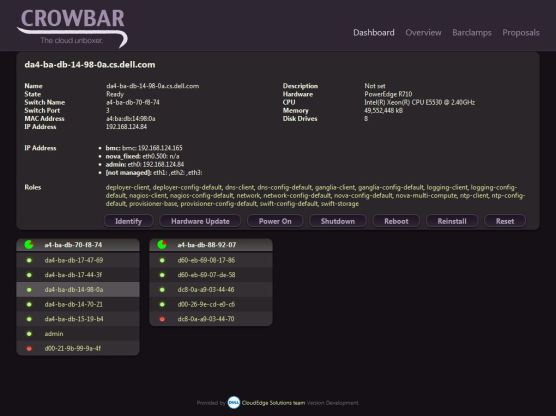
Dell Crowbar
- The final comment I’ll make is that we see this summer as an important time for OpenStack – Cactus is out, Diablo is around the corner, partners are joining the community daily, and customers are getting excited. More and more of our customers are finding out HOW REAL OpenStack, and are getting on board.
Dell is going to continue to be a mover and shaker in OpenStack, so keep an eye out on Dell as we prepare to make our next big move in OpenStack.
Head back here often to stay up to date, and you can also follow myself and other Dell OpenStack leads on Twitter – @jbgeorge, @zehicle, @barton808, and others.
Here’s to the summer of OpenStack!
More info:
- Dell’s OpenStack website (where you can get the “Bootstrapping OpenStack Clouds” technical whitepaper) – http://www.Dell.com/OpenStack
- To talk to someone about becoming a Dell OpenStack customer – OpenStack@Dell.com
- Dell customer Cybera’s blog on “Running OpenStack in Production” – http://www.cybera.ca/tech-radar/running-openstack-production-part-1-hardware
- Dell’s Cloud Evangelist’s blog – www.bartongeorge.net
- Dell’s Cloud Solution Architecht (and OpenStack expert) Rob Hirschfeld’s blog – www.RobHirschfeld.com
Until next time,
JOSEPH
@jbgeorge
Cybera, OpenStack, Rackspace Cloud Builders and Dell
.
Recently, Cybera, a non-profit Canadian outfit who’s core objective is to drive innovation among Canada’s tech community, recently blogged about their path to production, open source cloud instance based on OpenStack, with their first installment being on the topic of hardware.
Dell and Rackspace were fortunate to be called out as innovators in helping them on the path to the OpenStack cloud.
Here’s a quick excerpt on their server hardware choices:
We ordered four different types of servers (aka nodes). A management node (nova-api, nova-network, nova-scheduler, nova-objectstore), compute nodes (nova-compute, nova-volume), a proxy node (swift-proxy-server) and storage nodes (swift-object-*, swift-container-*, swift-account-*). All nodes were contained in the Dell C6100 chassis. Here are the specs:
Processor Sockets Cores Threads RAM Disk Management E5620 2 8 16 24 8 x 300 GB Compute X5650 2 12 24 96 6 x 500 GB Proxy E5620 2 8 16 24 4 x 300 GB Storage E5620 2 8 16 24 6 x 2 TB The disk on the compute nodes is used for VMs and volumes, which is to say:
- a portion can be used for VM instances, the files that back the VMs
- a portion can be used for volumes, the files that back the virtual hard disks for the VMs (technically speaking it’s logical volumes that back the virtual hard disks but you can think of them as files). See Managing Volumes.
.
It’s a great read, and I highly recommend anyone even remotely considering OpenStack to take a look, and follow them as they continue to provide the community updates on their journey. (The link to Cybera’s post is available at the end of this blog entry.)
As Dell announced a few months ago, we’re actively engaging telcos, hosters, service providers and others on getting them going on OpenStack today. We have OpenStack experts on staff developing product, working with the community, and driving innovative design – you probably recognize some of the names – Rob Hirschfeld, Greg Althaus, and a few others.
And we’re proud to say that Dell was the ONLY hardware solutions provider to have been part of the community since its creation in July 2010.
To date, we’ve
- Authored the wildly popular “Bootstrapping OpenStack Clouds” technical whitepaper, which details hyperscale design for multi-node OpenStack clouds
- Developed the as popular OpenStack tool, Crowbar, which deploys a MULTI-NODE OpenStack cloud in a matter of minutes rather than hours (yes, that “MULTI-NODE” differentiation is important). It also allows for certain infrastructure configuration, network discovery, and is the basis for the operational model we feel will be optimal for OpenStack management.
- Defined a reference architecture for OpenStack on Dell PowerEdge C cloud optimized servers
- Been developing relationships with a number of valued partners in the OpenStack community, such as Rackspace Cloud Builders, Citrix, Opscode and others, as we continue to get customers to a full OpenStack cloud.
If you’re looking to start on the path that Cybera has gone down with OpenStack as a cloud platform, we’d love to talk to you. Reach out to us at OpenStack@Dell.com.
And stay tuned – the best is yet to come. 🙂
More info:
- Cybera’s blog – http://www.cybera.ca/tech-radar/running-openstack-production-part-1-hardware
- Dell’s OpenStack website (including link to “Bootstrapping OpenStack Clouds” whitepaper) – http://www.Dell.com/OpenStack
- Video on Dell’s Crowbar tool – http://www.youtube.com/watch?v=4zgT-6G2fXA
- Rob Hirschfeld’s blog – http://www.robhirschfeld.com/
Until next time,
JBGeorge
@jbgeorge
Opscode announces Private Chef and Hosted Chef
.
Interesting news at the Velocity conference this week.
Opscode today announced their release of Hosted Chef, where Opscode offers their Chef capabialities “as a service”. Additionally, Opscode announced Private Chef, which is essentially Chef delivered as an appliance on premise.
Chef is an important part of what Dell is developing as part of our Crowbar tool that is being developed for OpenStack. By leveraging Chef cookbooks and recipes, and even contributing some of our own, it allows us to drive the operational model that we see as an important avenue to cloud technology.
What’s Crowbar? You can google or twitter it (#crowbar) to see what people in the know are saying, but at a basic level, it allows user to deploy an MULTI-NODE OpenStack cloud on bare metal Dell PowerEdge C servers in a matter of minutes. But it also offers BIOS configuration, RAID configuration, network discovery, and a number of other great benefits. If you’ve been to a recent cloud event or the last OpenStack Design Summit, you may have seen our live demo of it.
It’s just one of the many cool things we’re doing at Dell to better enable our customers to get to the cloud sooner rather than later, and to leverage OpenStack as a powerful cloud platform.
I’ve written about Dell’s OpenStack solution and Crowbar a lot, so you can check out my blog history for more. Or if you’d like to chat about it drop me a line at OpenStack@Dell.com.
These offerings certainly come at the right time for a market seeking some real cloud answers – congrats to our pals over at Opscode!
More info on the new offerings:
- Hosted Chef – http://www.opscode.com/hosted-chef/
- Private Chef – http://www.opscode.com/private-chef/
- The full press release – http://www.prnewswire.com/news-releases/opscode-delivers-cloud-infrastructure-automation-to-the-enterprise-123801144.html
Until next time,
JBGeorge
@jbgeorge
VIDEO: #Dell and #Citrix discuss #OpenStack at Citrix Synergy 2011
.
Sameer Dholakia, VP of Marketing at Citrix, and I had a chance to visit with the VM blog team while we were at Synergy 2011 last week, and we talked about OpenStack, Project Olympus and how Dell and Citrix are helping move the OpenStack movement forward.
Some key items we touch on:
- The history of OpenStack, where Dell and Citrix are pioneer community partners
- Citrix’s announcement of Project Olympus, which include be a distribution of OpenStack
- Core competencies that both Dell and Citrix bring to the OpenStack community
- How OpenStack fits into Dell’s mantra of open, capable, and affordable.
.
You can also read David Marshall’s Virtualization Report article on InfoWorld that details more about Dell, Citrix, OpenStack, and Project Olympus at https://www.infoworld.com/d/virtualization/citrix-commercializes-openstack-project-olympus-550?page=0,0
Learn more at www.citrix.com/olympus and www.dell.com/openstack.
You can also email me at OpenStack@Dell.com.
Enjoy!
Until next time,
JOSEPH
@jbgeorge
Citrix Synergy 2011: Day 2 – Simon Sez!
Hello (again) from San Francisco – for the last time this week!
I’ll be heading back to Austin tomorrow, but it was great being here in California for a few days, and being a part of what was happening at Citrix Synergy 2011.
Day 2 started a bit slow, but Simon Crosby certainly got us back on track.

Simon Crosby on stage at Citrix Synergy
Here are the highlights:
- DJ Solomon was running music before the session and at the after party – I gotta say I was impressed. I’m not a big club beat guy, but this was good tunage.
- Citrix Partner Awards: Gluster – Best Partner Solution for Accelerating Cloud and Best in Show! App-DNA wins best partner solution for desktop transformation, and Abiquo wins best partner solution for virtual datacenters.
- After the Citrix Partner Solution Awards, Simon Crosby took the stage – I’d been looking forward to this – Simon never fails to provide surprise and insight.
- It should be obvious, but a lot of people still don’t get this – virtualiztion is not the same thing as cloud. Does virtualization have a place in cloud? Yes. Can you evolve from a highly virtualized environment to a cloud? Yes. But there is a purer way taken advantage of all the inherent characteristics of cloud (elasticity, mutli-tenancy, etc) by designing and building cloud from the ground up – something that platforms like OpenStack offers. (Check out the whitepaper at www.Dell.com/OpenStack to learn more about that design methodology.)
- OpenStack will help drive what we need in the cloud – getting key vendors together to figure out and build the cloud out right. – Simon Crosby
- To delight (users) and to protect (enterprises) – that is the mission of IT – Simon Crosby
- Interesting analogy from Simon: private cloud vs private cloud similar to driving your own car vs flying in a commercial plane – we drive our own cars, have control, etc – commercial airlines focus on building in process so that air travel is safe and reliable. Interesting fact – the FAA was created by the airlines to help ease people’s fear of flying by implementing standards and a governing body.
- Enterprises are seeking economics, elasticity, and pay-as-you-go from the cloud. – Simon Crosby
- Our consumer choices are increasingly impacting our workplace – Simon Crosby
- Roughly 100% of users violate their company’s security policy to get their job done – apps, public cloud access, etc. It’s important that we as an industry recognize that and leverage it for progress.
- Tarkan Maner, CEO of Wyse – wow, quite a captivating speaker. Was quite comfortable making a number of claims about thin clients and the future of computing, a number of which I’m not in agreement with (there is now no need for thick clients, etc), but overall, I enjoyed his address. Some key takeaways include cloud recommendations: start working toward hybrid cloud, build based on policies, develop to open standards, ensure the right and evolved IT skills are in place, and put users before infrastructure.
- Also learned a new phrase – “FInT this.” = Facebook, Linked In, Twitter. Do any of you actually say this?
-
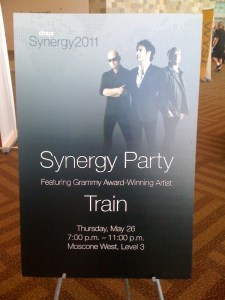
- Train at Citrix Synergy!
Zynga CTO Allan Leinwand also presented today speaking about their zCloud – they went from concept to production in 6 months, and can provision 1000 servers within 24 hours now. They are all about “scale fast or fail fast.” Nice to see that we as a group are starting to understand this notion. Nice quote to the crowd during his discussion: “Some of you might be playing our games right now.”
- Also got a chance to interact with friends in the press as well as users who wanted to know more about OpenStack and Dell’s role in Project Olympus and its Early Access Program. You can also drop me an email at OpenStack@Dell.com if you want to learn more.
- And to top it all off – Train in concert at the Synergy afterparty!
The twitterati was in full swing as well – check out #CitrixSynergy.
Citrix fans – it’s been fun – see you next year!
Until next time,
JOSEPH
@jbgeorge
 The JBGeorge Tech Blog